Soil organic carbon is the carbon held in decomposing plant and animal material, microbes and humus. It makes up the bulk of soil organic matter, which holds water and nutrients, builds aggregates and feeds the soil food web. Because soils store far more carbon than the atmosphere holds in some estimates, interest has grown in whether farm management could pull carbon dioxide out of the air and lock it in the ground. The reality is promising but more modest and uncertain than slogans suggest.
How soil carbon accumulates
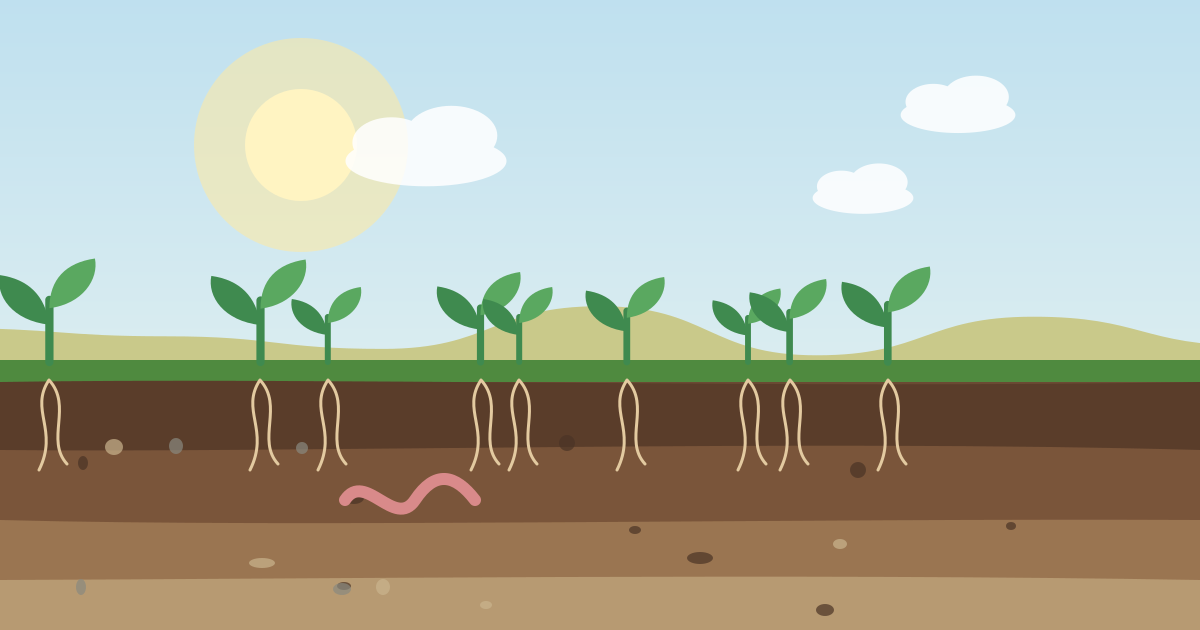
Plants take carbon dioxide from the air through photosynthesis. Some of that carbon goes into roots, root exudates and residue that enter soil. Microbes process this material, and a portion becomes stable organic matter, protected in aggregates or bound to mineral particles. Meanwhile, microbial respiration returns carbon to the air as carbon dioxide. Soil carbon rises when inputs exceed losses. Tillage, bare fallow, low residue and erosion speed losses.
Rates depend strongly on climate, soil texture, starting carbon and management. Cool, wet and fine-textured soils tend to hold more carbon, and degraded soils with low carbon can gain faster than soils that are already high. The USDA's Agricultural Research Service and land-grant universities run long-term experiments that document change over decades.
Practices with the strongest support
- Cover crops. Adding roots and biomass during otherwise fallow periods raises carbon inputs. Studies often show modest average gains. See cover cropping.
- Diverse rotations and perennials. Adding perennial forages, small grains and deep-rooted crops increases carbon inputs and reduces disturbance. See crop rotation.
- Reduced tillage and no-till. No-till reduces losses and improves structure and can concentrate carbon near the surface. Evidence on total carbon gain through the whole profile is mixed, and gains can be small. See reduced tillage.
- Organic amendments. Compost and manure add carbon directly, and the effect depends on rates and source. See compost use.
- Managed grazing. Improved grazing management can increase forage production and root inputs on some pastures. Results vary. See adaptive grazing.
- Agroforestry and buffers. Trees add carbon in biomass and sometimes soil. See agroforestry.
- Conversion of cropland to permanent cover. Programs like the Conservation Reserve Program can lead to carbon gains over time.
How much to expect
Reported gains vary widely. A common range from studies of conservation practices is a fraction of a metric ton of carbon per acre per year, with variation across sites, and rates often slow as soils approach a new equilibrium after ten to twenty years. Gains can plateau, and they can be lost within years if tillage resumes or cover is dropped. Treat any promise of dramatic annual gains with caution. You can estimate effects for your fields with USDA's COMET-Farm tool, but it provides model estimates, not measurements.
Why measurement is hard
- Slow change against high background. A change of a few tenths of a percent in organic matter takes years to detect against natural variability.
- Spatial variability. Carbon varies across a field, so sampling design matters.
- Depth. Practices can change the distribution of carbon with depth without changing the total, so shallow samples can mislead.
- Bulk density. Changes in soil density affect results calculated on a volume basis. Methods that account for equivalent soil mass are more reliable.
- Cost. Intensive sampling is expensive, and models fill gaps with uncertainty.
If you want to track your own soils, sample at the same points and time of year, at consistent depths, with the same lab, and keep notes on management. See the soil testing guide.
Permanence and leakage
Carbon in soil is not permanent unless management continues. Programs and buyers deal with this through contracts of fixed length and rules about reversals. Another concern is leakage, where practices in one place cause more emissions elsewhere, such as increasing production on other land. These issues are central to carbon markets and carbon contract risks.
What a farmer can see
Long before a lab test shows a change, you can often see it. Darker topsoil, a crumbly structure that breaks into small aggregates, more earthworm activity, water that soaks in instead of ponding, and a field that stays workable after a hard rain are all signs that organic matter is doing its job. Photograph a spade-full of soil from the same spots each fall and compare year to year. These observations will not satisfy a carbon registry, but they tell you whether your management is moving soil in the right direction.
Build carbon for soil function
The strongest reasons to manage for soil carbon are agronomic. More organic matter generally means better structure, water holding capacity, nutrient cycling and resilience. Even if carbon markets disappoint, the practices that build it also cut erosion, reduce costs and support yields. Think of credits or payments as a possible bonus.
Funding and help
NRCS conservation practices that support soil carbon include cover crop, residue and tillage management, conservation crop rotation, prescribed grazing, tree and shrub establishment and conservation cover, all eligible for EQIP and CSP in many states. The NRCS soil health pages provide context. The USDA Climate Hubs offer regional guidance on carbon and climate-smart practices. Contact local offices through the directory.
A practical plan
- Take a baseline of soil organic matter at fixed points.
- Pick two or three practices that fit your system, such as cover crops and a longer rotation.
- Keep records of inputs, residue, grazing and cover.
- Resample every few years under the same protocol.
- Use COMET-Farm to compare scenarios and plan.
- Check payment programs carefully before committing.
Bottom line
Soil carbon practices are worth doing, but they build slowly, vary by site and can reverse. Focus on practices with a record of improving soil function, measure carefully and approach carbon payments with realistic expectations and a close reading of contracts.
Frequently asked questions
Can farming practices really store carbon in soil?
Some practices can increase soil organic carbon, but gains vary by climate, soil and management, are often modest and can be lost if practices stop.
Which practices build the most soil carbon?
Cover crops, diverse rotations with perennials, organic amendments, improved grazing and conversion to permanent cover have the strongest support, with results varying by site.
How can I measure soil carbon on my farm?
Sample the same locations at consistent depths and times with the same lab, and keep management records. Use tools such as COMET-Farm for estimates.
Is no-till a carbon solution?
It reduces losses and improves structure, but evidence on total profile carbon gains is mixed.